
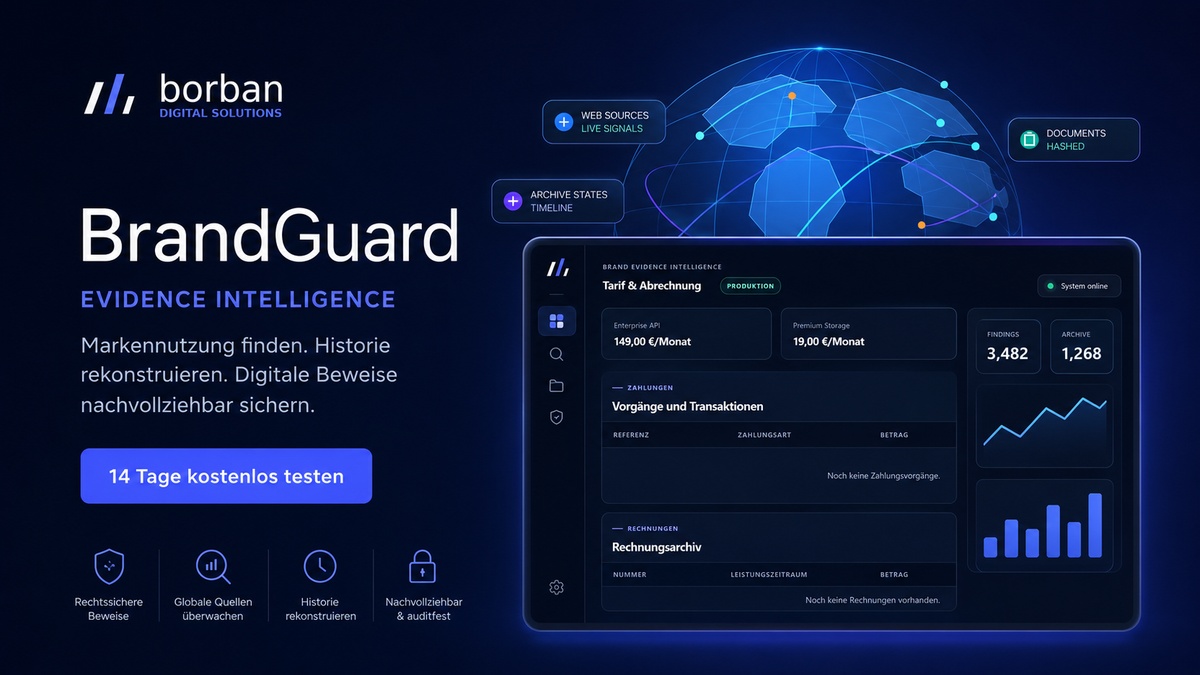
Rheinberg, 29 July 2026 — The platform developed by borban combines discovery of possible trademark use with technical website analysis, historical reconstruction, monitoring and structured digital evidence preservation.
Digital trademark use is distributed and volatile
Possible trademark infringements do not appear only on familiar homepages. They may be hidden in previously unknown stores, deep product pages, internal search results, price lists, PDF documents or product images. Digital content also changes quickly: names are replaced, documents overwritten, redirects introduced and pages removed. Reliable research therefore has to connect discovery, context and chronological development.
Research starts across the web
BrandGuard does not require users to know a suspicious domain in advance. After entering a trademark, the platform can use connected public search sources to research exact matches, controlled spelling variants, separators and plausible typographical errors. Findings are grouped by domain, checked technically and prioritised using transparent signals. Relevant domains can then be transferred directly into an in-depth investigation project.
Deep analysis instead of isolated search results
A single search result usually represents only a small part of a website. The BrandGuard crawler therefore maps the publicly accessible area systematically, taking account of internal links, sitemaps, product and document URLs and typical e-commerce routes. In addition to visible text, it records titles, headings, canonicals, redirect chains, structured data, indexing directives and public headers. Source, location and technical context remain separately traceable.
OCR and historical research close important gaps
Trademark terms are often visible only on packaging, product photographs or scanned PDF pages. BrandGuard can analyse these materials using optical character recognition while documenting the source and confidence of the recognition. Where external archives provide data, earlier page states are researched and placed in chronological context. Missing archive captures are identified as a limitation and are not treated as proof that a page did not exist.
Technical evidence preservation goes beyond screenshots
Depending on the source and project configuration, BrandGuard can preserve screenshots, browser PDFs, HTML, original PDFs, technical headers, redirects, extracted text, OCR results and metadata. Source files remain separate from subsequent analysis. SHA-256 checksums are generated and combined with sources, capture times and technical information in manifests. This records integrity but does not claim to create a qualified external timestamp or determine evidential weight in court.
Monitoring and the Legal Workspace connect research with case work
Trademark projects can be checked repeatedly. New domains, changed pages, additional historical material and shifts in priority become visible within shared evidence cases. Results can be assigned to clients, legal matters, parties, deadlines and supplementary documents. Exportable evidence packages combine reports, tables, timelines, files, metadata and checksums instead of producing disconnected files.
A future module will map distribution channels and economic reach
As its next extension, borban is developing a module to reconstruct publicly visible distribution networks. Historical retailer findings, product variants, prices, sales indicators, branch networks and distribution periods are intended to be combined. Planned revenue ranges will clearly distinguish verified facts, publicly documented indications and necessary assumptions. They are designed to support an initial economic assessment, not replace internal sales records or formal commercial information.
Technical support without an automated legal decision
BrandGuard does not decide whether trademark infringement has occurred. The platform documents publicly accessible content, technical states, sources, chronological changes and risk signals. Legality, responsibility and potential claims must be assessed by qualified professionals in the individual case. This separation is part of the methodology and prevents technical uncertainty from being presented as a definitive legal conclusion.
About BrandGuard
BrandGuard is a B2B platform developed by borban for web-wide trademark research, technical website analysis, historical web research, continuous monitoring and digital evidence preservation. The system is developed by Boris Banaszak and operated as part of the software portfolio of Borban Digital Solutions.